Petrol Prices in Pakistan

Stay updated with the latest fuel prices across all major cities

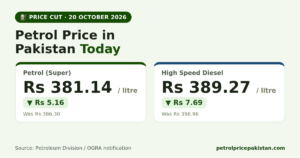
Current Fuel Prices after RS 55 Hike

March 7, Updated prices as per OGRA notification

Fuel TypePrice (Rs/L)IncreasePercentage

Petrol

321.17▲ +63.0024.4%

High Speed Diesel (HSD)

335.86▲ +60.1621.8%

Kerosene Oil

428.74▲ +252.94143.9%

Light Diesel Oil (LDO)

428.74▲ +274.33177.7%

High-Octane Petrol

535.00▲ +276.83107.2%

Crude Oil Prices

25/03/2026

OilsPricePercentage
Crude Oil90.132-2.40%
Brent101.280-3.07%
Natural gas2.95890.54%
Gasoline2.9530-6.19%
Heating Oil3.92920.3366
fuel cost calculator for petrol price
#
City
Petrol
Diesel
1Karachi321.17335.86
2Lahore321.17 – 321.50335.86 – 336.20
3Islamabad321.17 – 321.50335.86 – 336.20
4Rawalpindi321.50 – 322.00336.00 – 336.50
5Faisalabad321.20 – 321.70335.90 – 336.30
6Multan321.30 – 321.80336.00 – 336.40
7Peshawar322.00 – 322.50336.50 – 337.00
8Quetta326.00 – 328.00340.00 – 342.00
9Gilgit330.00 – 332.00

344.00 – 346.00

Prices reflect ex-depot rates plus dealer margins. Actual pump prices may vary by station

Petrol Price in UAE & Dubai 🇦🇪

Fuel Price Per Liter

Special 95 2.48 AED | Super 98 2.59 AED | Diesel 4.41 AED | E-plus 91 2.40 AED
18/03/2026

Fuel Price Per Liter 18/03/2026

Special952.48 AED
Super982.59 AED
Diesel4.41 AED
E-plus912.40 AED

Petrol Price Impacts

LPG Gas Price Today​

Category
New Price
Previous Price
Changes
Domestic Cylinder 11.8 KG
2734.77 RS
2749.41 RS
RS - 14.63
Commercial Cylinder 45.4 KG
10,521.94 RS
10,78.40 RS
RS -56.30
Gas Price
281 RS
261 RS
20 RS

Pakistan Fuel Reality

37+0M

Registered Vehicles

0M liters

Daily Petrol Consumption

0Billion

PAK Daily Spends

0Billion Annually

Rs.1 increase

Petroleum Price History Era Of PMs

FAQs

Can I use high-octane petrol in my 70cc motorcycle?

Yes, but you absolutely should not. A 70cc or 125cc motorcycle engine cannot utilize the extra octane rating of HOBC fuel .

The engine compression ratio on these bikes is designed for 87-92 RON fuel. Using 97 RON high-octane petrol provides:

  • No power increase, No mileage improvement

  • No engine protection benefit

  • Only higher cost

Petrol prices in Pakistan are high due to a combination of government levies, customs duties, dealer commissions, and oil marketing company margins, not just the base price of crude oil. As of March 2026, government levies alone account for over Rs. 124 per litre on petrol. These include:

  • Petroleum Levy: Rs. 84.40 per litre

  • Customs Duty: Rs. 13.31 per litre

  • Climate Support Levy: Rs. 2.50 per litre

  • Dealer Commission: Rs. 8.64 per litre

  • OMC Margin: Rs. 7.87 per litre

Additionally, global oil prices, exchange rate fluctuations, and supply chain disruptions (such as the Strait of Hormuz closure) directly impact import costs

Petrol prices in Pakistan are regulated by the Oil and Gas Regulatory Authority (OGRA) , which determines ex-refinery prices based on the import parity price (IPP) formula . The federal government then approves the final consumer price after incorporating:

  • International refined product prices (Arab Gulf FOB Platts assessments)

  • Freight and insurance costs

  • Inland Freight Equalization Margin (IFEM)

  • Dealer commissions and OMC margins

  • Government levies and duties

Currently, petrol prices are revised every 15 days (fortnightly) , with announcements typically made on the 1st and 16th of each month. However, due to extreme volatility in global oil markets, exacerbated by the Iran conflict and Strait of Hormuz closure, the government is now considering shifting to weekly or even daily price adjustments under IMF recommendations .

The last major revision on March 7, 2026 saw prices increase by Rs. 55 per litre, pushing petrol to Rs. 321.17 . This frequent volatility makes real-time tracking essential for consumers.

  • International refined product prices (Arab Gulf FOB Platts assessments)

  • Freight and insurance costs

  • Inland Freight Equalization Margin (IFEM)

  • Dealer commissions and OMC margins

  • Government levies and duties

Currently, no sales tax is applied to petrol or diesel in Pakistan . However, prices remain elevated due to other levies and duties:

  • Petroleum Levy: The largest component

  • Customs Duty: Applied on imports

  • Climate Support Levy: A newer charge introduced in 2026

Despite the absence of general sales tax (GST), the combined levies and margins effectively double the base price of fuel. For example, petrol’s base price is approximately Rs. 133 per litre, but consumers pay Rs. 321+ at the pump

Petrol prices vary by city due to the Inland Freight Equalization Margin (IFEM) a mechanism that adds transportation costs to ensure uniform pricing across the country, but ironically creates variations .

Cities farther from refineries and import terminals pay higher prices due to:

  • Distance from Karachi port (where most fuel is imported)

  • Distance from refineries (PARCO, ARL, NRL, PRL, Cnergyico)

  • Road freight costs for tanker transport

  • Regional dealer commission variations

For example, Quetta and Gilgit consistently have higher prices than Karachi because of their remote locations and difficult terrain .

IFEM (Inland Freight Equalization Margin) is a mechanism that adds transportation costs to petrol and diesel prices to ensure uniform pricing across the countrythough it actually creates the variations you see between cities .

When fuel is transported from refineries or import terminals to different cities, the government calculates the freight cost and adds it as IFEM. This ensures consumers in remote areas don’t pay the full distance-based cost, but the margin still increases prices compared to port cities like Karachi.

OGRA computes and notifies IFEM monthly based on:

  • Pipeline and road freight rates

  • Distance from refineries/terminals

  • Transportation mode (pipeline vs. tanker)

Petrol price increases have a cascading effect on the entire economy because fuel is a basic input for transport, agriculture, and power generation .

Within hours of a price hike, consumers experience:

  • Transport fare increases: Bus fares rise by Rs. 10-30 per route; inter-city fares double (e.g., Peshawar-Lahore from Rs. 2,000 to Rs. 3,000)

  • Food price inflation: Vegetable and fruit prices jump 20-25% within days due to higher transport costs

  • Ride-hailing surge: App-based services increase fares, reducing demand

  • Household budget pressure: Middle and lower-middle-class families bear the brunt