
June 16, 2026
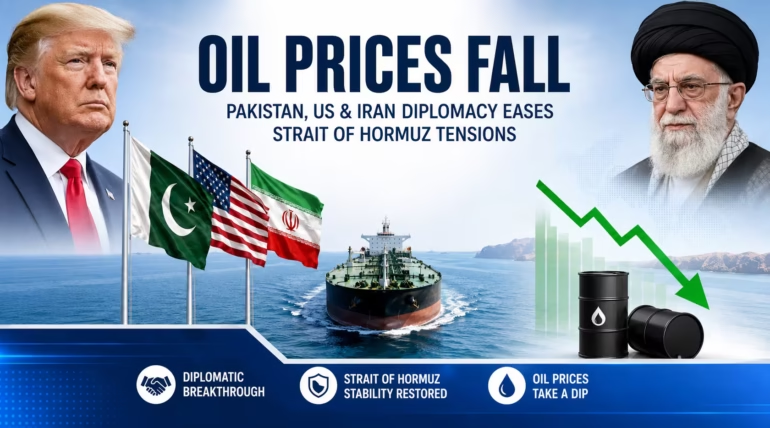
In a major development for the world, the US Iran both have reached a peace agreement after many weeks of talks. Pakistan played a very important role in bringing both sides together. This news is already affecting global oil markets, and it could mean good news for petrol prices in Pakistan.
What Happened Recently? (Latest Updates)
Pakistan’s Prime Minister Shehbaz Sharif announced on Monday that both the US and Iran have agreed to stop all military actions against each other. The official signing of this agreement will take place on Friday, June 19, in Geneva, Switzerland.
US President Donald Trump also confirmed the news on his social media account. He said that the Strait of Hormuz—a very important sea route for oil shipments—will now be fully open for all ships. He also ordered the removal of the US naval blockade on Iranian ports. In his words: “Ships of the World, start your engines. Let the oil flow!”
Iran’s officials have also accepted the draft agreement, though they said they still do not fully trust the US. Iran’s Foreign Minister said that talks about Iran’s nuclear program and the removal of sanctions will continue for the next 60 days after the signing.
What is in This Agreement?
The deal has two main parts:
-
Immediate Action: Iran will reopen the Strait of Hormuz, and the US will lift its naval blockade. This means oil tankers can move freely again, which will increase the supply of oil in the world.
-
Sanctions Relief: The US has agreed to suspend sanctions on Iran’s oil and petrochemical exports. Iran will also get access to around $24–25 billion of its frozen money in foreign banks. This is a big relief for Iran because its economy is in bad shape. Prices of basic goods in Iran have gone up a lot—meat prices have risen by 176%, dairy by 161%, and cooking oil by 267% compared to last year.
However, some difficult issues are still not solved, such as Iran’s nuclear activities and missile program. These will be discussed in the next 60 days.
How Will This Affect Petrol Prices?
The news of the deal has already caused a drop in global oil prices. Brent crude oil fell by nearly 5% to around $83 per barrel**, and US oil also dropped to about **$80 per barrel. This is a big drop from the earlier prices of over $110–120 per barrel when tensions were high.
However, experts are advising caution. They say that the details of the deal are still not fully clear, so the market may remain uncertain for some time. Also, reopening the Strait of Hormuz and restoring normal oil trade will not happen overnight. Ships need to clear mines from the waterway, and it will take time for everything to return to normal. That is why oil prices went back up a little on Tuesday.
Still, if the deal holds and oil flows freely, we can expect petrol and diesel prices to come down in the coming weeks, which will be good news for Pakistani consumers.
Pakistan’s Important Role in This Deal
Pakistan has received a lot of praise from the whole world for its role in this agreement. The UN Secretary-General thanked Pakistan, along with Qatar, Egypt, Saudi Arabia, and Turkey, for helping with the negotiations.
Turkish President Erdogan, UK Prime Minister Keir Starmer, Chinese officials, and Japanese diplomats all appreciated Pakistan’s efforts. Pakistan is in a unique position because it has good relations with both the US and Iran. Earlier this year, Pakistan also hosted top officials from both countries for talks.
Deputy Prime Minister Ishaq Dar called this a “major diplomatic achievement” for Pakistan and said it could bring peace and stability to the whole region.
How Other Countries Are Reacting
Most countries have welcomed this deal. Gulf nations like Saudi Arabia and the UAE have supported it, while Egypt called it a “highly significant” step. Qatar described it as a “major breakthrough” that can bring stability to West Asia.
But there are still some challenges. Israel’s Prime Minister Netanyahu has not shown any sign of stopping his military actions, and Israeli officials have warned that they will attack Iran if they feel threatened. The US has also said it could take military action again if Iran does not agree to a final nuclear deal in the future.
What Happens Next?
The next important date is June 19, when the agreement will be formally signed in Geneva. After that, the two countries will start 60 days of tough talks to solve the remaining issues about Iran’s nuclear program and sanctions.
For now, the world is breathing a sigh of relief. The risk of a major war in the Middle East has gone down, and oil supplies are expected to improve. For Pakistan, this is a proud moment because we helped make this happen. And if petrol prices drop, it will bring much-needed relief to the common man.