Faisalabad Electric Suppy Company – Serving & Districts
✓ Free ✓ No Sign up ✓Instant Result ✓ Mobile Friendly
Reference No. & Consumer ID Due Date Tariff Rates Bill History Complaint Helpline
Enter your 14‑digit FESCO reference number. We'll open the official portal and copy your number automatically.
Faisalabad Electric Supply Company — estimate your monthly electricity bill
Consumer details
Units consumed this month
Time-of-Use units
Monthly adjustments (check your latest bill)
Bill summary
Slab-by-slab breakdown
| Units range | Rate (Rs/kWh) | Units in slab | Charge (Rs) |
|---|
Table of Contents
ToggleFESCO stands for Faisalabad Electric Supply Company, one of the ten electricity distribution companies (DISCOs) that emerged from the unbundling of WAPDA’s power wing. FESCO operates under Pakistan’s Ministry of Energy (Power Division) and is regulated by the National Electric Power Regulatory Authority (NEPRA) under its Distribution Licence.
FESCO is responsible for distributing and supplying electricity to roughly 5.4 million consumers, covering a population of more than 26 million people across central and northern Punjab. Its core mandate — as set out in its mission — is to provide reliable, affordable and safe electricity, with a particular focus on keeping the region’s industrial and agricultural sectors competitive.
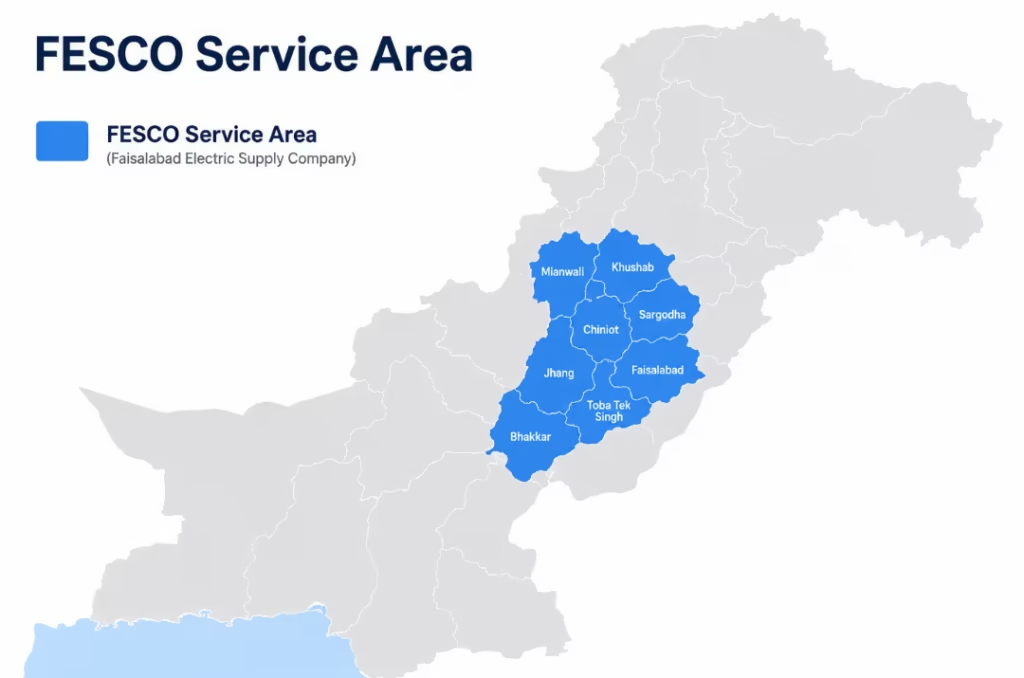
FESCO’s geographical service territory includes the following districts:
District | Notes |
Faisalabad | Head office and largest consumer base; major industrial hub |
Jhang | Mixed domestic, agricultural, and industrial load |
Toba Tek Singh (T.T. Singh) | Predominantly agricultural and domestic |
Chiniot | Domestic and small industrial (textile, hardware) |
Sargodha | Agricultural belt, citrus farming region |
Mianwali | Domestic and agricultural, lower density |
Bhakkar | Predominantly rural and agricultural |
Khushab | Mixed domestic, industrial (cement, salt), and agricultural |
Metric | Detail |
Full name | Faisalabad Electric Supply Company (FESCO) |
Parent framework | Ex-WAPDA Distribution Company (XWDISCO) |
Regulator | NEPRA (National Electric Power Regulatory Authority) |
Consumers served | ~5.4 million |
Population covered | 26 million+ |
Districts covered | 8 (see table above) |
Bill check requirement | 14-digit Reference No. or 10-digit Customer ID |
Complaint helpline | 118 (toll-free, nationwide DISCO complaint line) |
| Faisalabad District | Faisalabad City, Jaranwala Chak, Jhumra Saddar, Tandlianwala, Sammundari |
| Sargodha District | Sargodha City, Sillanwali, Sahiwal, Bhera, Shahpur, Bhalwal, Kot Momin |
| Jhang District | Jhang City, Ahamd Pur Sial, 18-Hazari, Shorkot |
| Toba Tek Singh District | Toba Tek Singh City, Pir Mahal, Kamalia, Gojra |
| Bhakkar District | Bhakkar City, Darya Khan, Mankera, Kallur Kot |
| Khushab District | Khushab City, Noorpur Thal, Naushera, Quaidabad |
| Mianwali District | Mianwali City, Isa Khel, Piplan |
| Chiniot District | Chiniot City, Lalian, Bhowana |
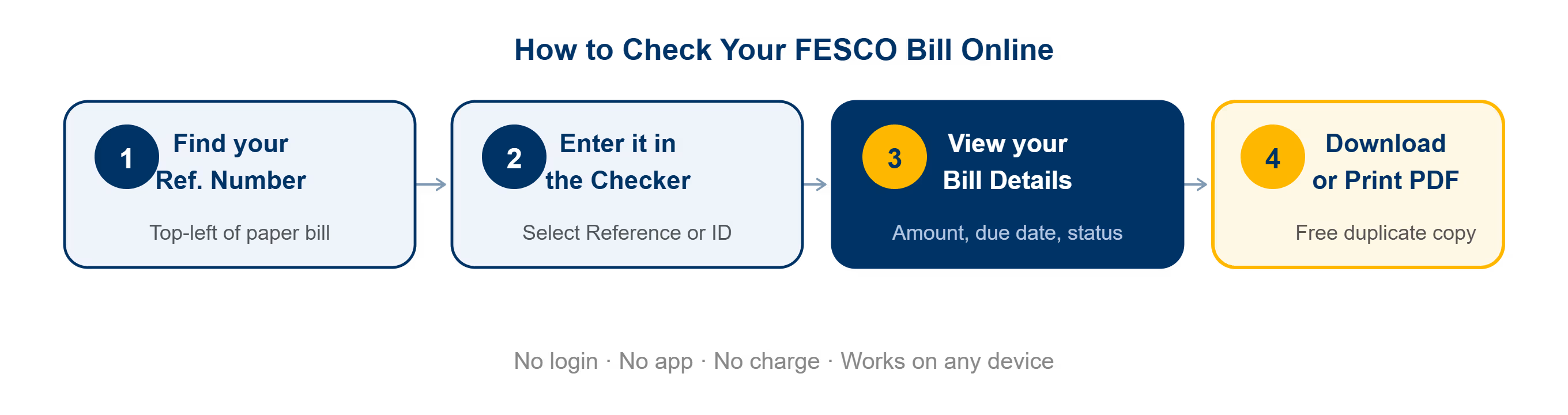
Checking your FESCO bill online takes less than a minute once you have the right number in front of you. Here’s exactly how to do it:
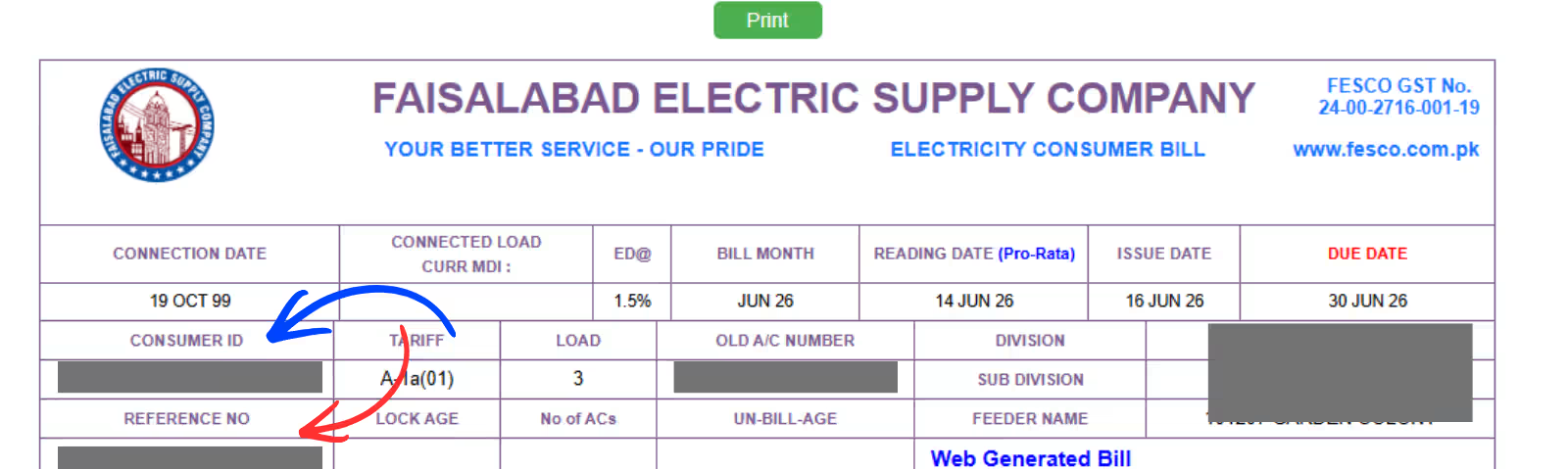
Pick up your most recent FESCO paper bill. In the billing details box (usually top-left), you’ll see two numbers:
Either number works with the checker above — pick whichever is clearer on your bill.
Scroll back to the FESCO Bill Checker widget at the top of this page. Select whether you’re entering a Reference Number or Customer ID using the toggle, then type the digits carefully — the live counter helps you confirm you’ve entered the full number.
The tool fetches your current bill record. Within a few seconds, you’ll see:
From the results screen, you can:
That’s it — no login, no OTP, no app download required.
This is the most common point of confusion, so here’s a clear breakdown:
Tip: If you’ve lost your paper bill entirely and don’t know either number, visit your nearest FESCO Customer Services Centre with your CNIC — staff can look up your account using your name, address, or meter number.
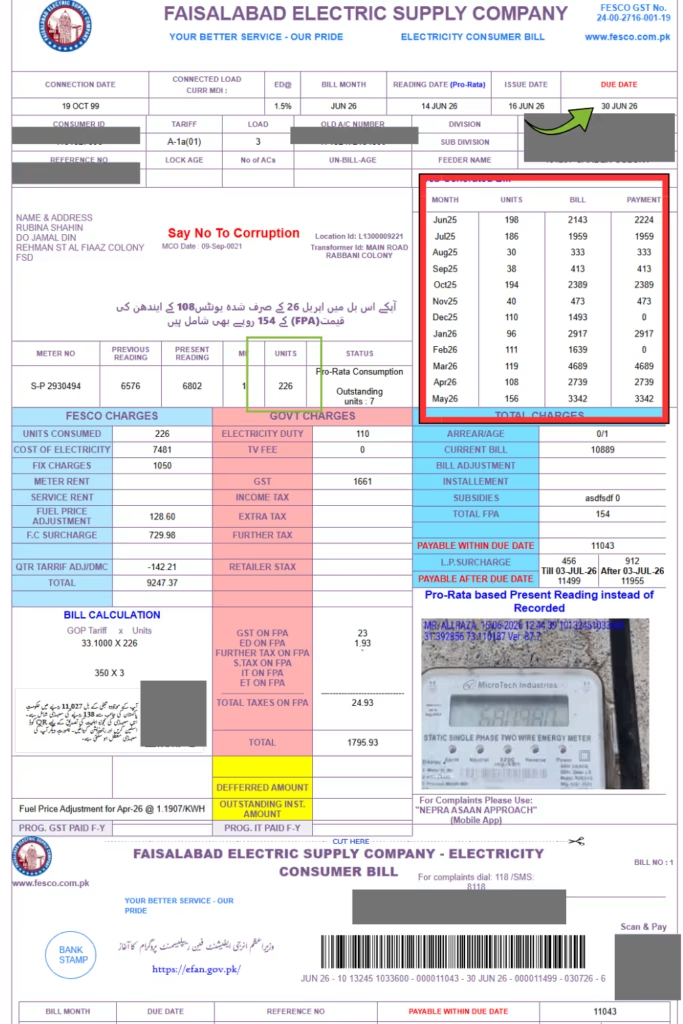
A FESCO bill can look intimidating with all its codes and abbreviations. Here’s what each section actually means.
This block contains your name, billing address, tariff category (e.g., A-1 Residential, A-2 Commercial), sanctioned load, meter number, and feeder/circle information. Always check that your name and tariff category are correct — an incorrect category (e.g., being billed as commercial when you’re a residential consumer) can significantly inflate your bill and is grounds for a request for correction.
If your units consumed look unusually high compared to previous months, check the bill history (see below) before assuming it’s an error — but if it’s clearly abnormal, this is your starting point for a billing complaint.
Your tariff category (domestic, commercial, industrial, agricultural, or general supply) determines which NEPRA-notified rate table applies. Within domestic tariffs, the per-unit rate increases in slabs based on total monthly consumption — lower-consumption households (especially “lifeline” consumers using up to 50 units/month) pay heavily subsidized rates, while higher-consumption households pay progressively more per unit. See the full tariff table below.
A government sales tax is applied to the electricity charges portion of your bill. The rate is set by federal tax policy (commonly 17% for most non-lifeline consumer categories) and can change with the annual Finance Act — lifeline consumers are typically exempt or pay a reduced rate.
FPA (also referred to as Fuel Cost Adjustment, FCA, or Quarterly Tariff Adjustment, QTA, depending on the mechanism) is a variable charge that reflects the actual cost of fuel used to generate electricity in a given month or quarter compared to the cost assumed in the base tariff. It can be a positive charge (you pay extra) or a negative adjustment (you get a discount) — in mid-2026, for example, NEPRA approved a multi-rupee-per-unit reduction for several months as relief to consumers. This is why your per-unit cost can vary noticeably month to month even if your tariff slab hasn’t changed.
A fixed surcharge, approved by NEPRA, is meant to cover financing costs related to the power sector’s circular debt. It’s applied per unit and is separate from FPA.
The Net Payable Amount is the bottom-line figure — the sum of energy charges, taxes, surcharges, and any arrears, minus any adjustments. The Due Date is the last date to pay the lower amount; missing it triggers the late-payment amount shown alongside it.

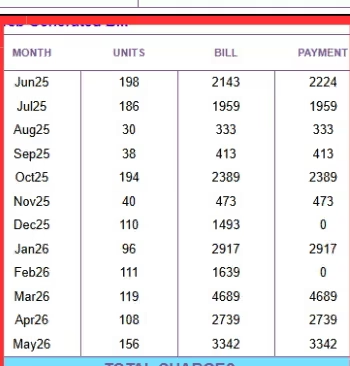
After checking your bill, this section displays a simple chart of your units consumed and the amount payable over the past 12 months. Why this matters:
Once you've checked your bill, here are every way you can pay it:
You’ll receive an instant confirmation SMS/receipt — keep it as proof of payment.
Most major banks support FESCO bill payment through their apps and web portals, including:
The process is broadly the same: Utility Bill Payment → Electricity → FESCO → enter Reference Number → Confirm.
Most 1-Link-connected bank ATMs offer a “Utility Bill Payment” option on the main menu. Select Electricity, choose FESCO (or enter the reference number directly if prompted), confirm the amount, and collect your receipt.
Tip: Online and app-based payments are typically reflected in FESCO’s system within minutes to a few hours, which helps you avoid late payment surcharges if you’re paying close to the due date — over-the-counter payments can sometimes take a day or two to reflect.
Need a new electricity connection for a home, shop, or factory? Here's what's involved.
Document | Domestic | Commercial/Industrial |
CNIC copy of the applicant | ✅ Required | ✅ Required |
Proof of ownership/tenancy agreement | ✅ Required | ✅ Required |
Recent passport-size photographs | ✅ Required | ✅ Required |
Copy of a neighboring consumer’s bill (for site reference) | Often required | Often required |
Load requirement/wiring completion certificate | ✅ Required | ✅ Required |
No Objection Certificate (NOC) | Not usually needed | Often required, depending on load/location |
Business registration documents | — | Often required |
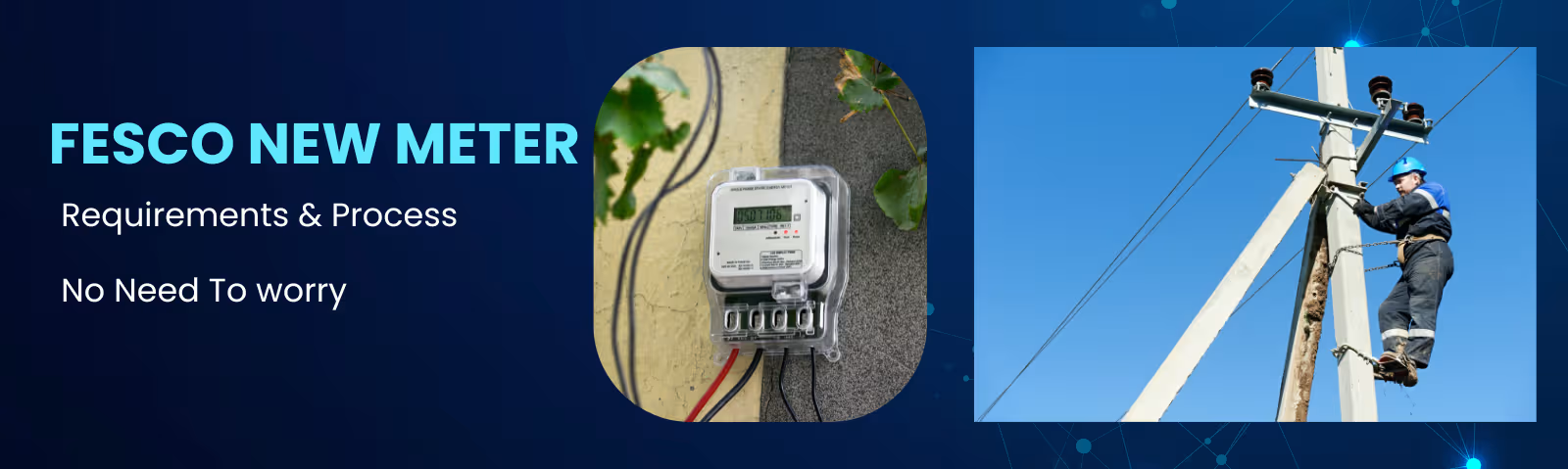
Three-phase meters are typically required for:
Approval for three-phase connections generally involves additional technical review and may take longer than single-phase domestic connections.
If you’ve bought a property with an existing connection, or your usage pattern no longer matches your billed category, you can apply for:
Something's wrong with your bill, meter, voltage, or supply, here's how to escalate it:
Issue Type | Where to Go |
General complaints (billing, meter, voltage, outages) | Call 118 (toll-free helpline) |
Billing disputes/overbilling | Visit your nearest FESCO Sub-Divisional/Customer Services Centre with your bill and CNIC |
Meter faults/tampering reports | Report to your local linesman or Sub-Division office |
New connection/load enhancement queries | FESCO Sub-Divisional Office for your area |
Net metering applications | FESCO Net Metering Cell / relevant Sub-Division |
In the case of incorrect reading, wrong tariff category, or unexplained spike:
Small habit changes can meaningfully reduce your monthly units — and potentially keep you in a cheaper tariff slab:
This page is an independent, informational bill-lookup tool and is not the official website of FESCO, PITC, WAPDA, or NEPRA. Tariff rates, taxes, surcharges, helpline numbers, and procedures are subject to change by official notification — always verify amounts, due dates, and procedures against your physical bill or FESCO's official channels (fesco.com.pk) before making payments or decisions based on this information.
Last updated: 18 jun 2026 — tariff figures reflect NEPRA notifications current as of that date and are subject to monthly/quarterly adjustment.
Enter your 14-digit Reference Number or 10-digit Customer ID into the FESCO Bill Checker at the top of this page and click "Check Bill." Your latest bill — including units consumed, total amount, and due date — will appear instantly.
It's printed in the billing details box, usually in the top-left corner of your paper bill, as a 14-digit number. Your 10-digit Customer ID is typically printed just above or beside it.
Yes. After checking your bill, click "View Full Bill" and then "Download PDF" to get a duplicate copy that's valid for payment at banks, ATMs, and mobile wallets.
FPA stands for Fuel Price Adjustment (also called Fuel Cost Adjustment or Quarterly Tariff Adjustment). It's a variable charge — which can increase or decrease your bill — based on changes in the actual cost of fuel used for power generation compared to the assumed cost in the base tariff.
You can pay via JazzCash, EasyPaisa, mobile/internet banking apps (HBL, UBL, MCB, Meezan, ABL, NBP, and others), or at ATMs — just enter your 14-digit Reference Number under "Electricity Bill Payment."
Pakistan’s trusted source for accurate fuel prices, historical data, smart calculators, and expert insights, helping you understand the real impact of petroleum costs.
This website is an independent informational platform created to help people understand fuel prices, not to influence policy or represent any government authority. Fuel prices are verified using official government sources including OGRA and the Ministry of Finance.
Copyright All right reserved © Petrol Price Pakistan-2026