

August 8, 2026
The Mecca Defence Agreement signed on August 7, 2026, by Saudi Arabia, Pakistan, and Turkey is a trilateral military security and collective deterrence alliance. It does not contain provisions for commercial trade, crude oil subsidies, or discounted fuel supplies. Domestic petrol and diesel prices in Pakistan will not decrease as a direct result of this pact. Fuel prices in Pakistan remain strictly governed by global crude oil market benchmarks, currency exchange rates, shipping margins, and government levies.
What Is the Mecca Joint Defence Agreement?
On August 7, 2026, Saudi Crown Prince Mohammed bin Salman, Turkish President Recep Tayyip Erdoğan, and Pakistani Prime Minister Shehbaz Sharif convened at Al-Safa Palace in Mecca to sign the Mecca Joint Defence Agreement (MJDA).
Core Clauses & Structure of the Alliance
-
Collective Defence Principle: Grounded in Article 51 of the UN Charter, the core provision states that an armed attack against any one of the three member states will be treated as an attack against them all.
-
Tripartite Synergies: The alliance combines Saudi Arabia’s financial resources, Turkey’s advanced defense-industrial base, and Pakistan’s combat-tested military manpower and nuclear capabilities.
-
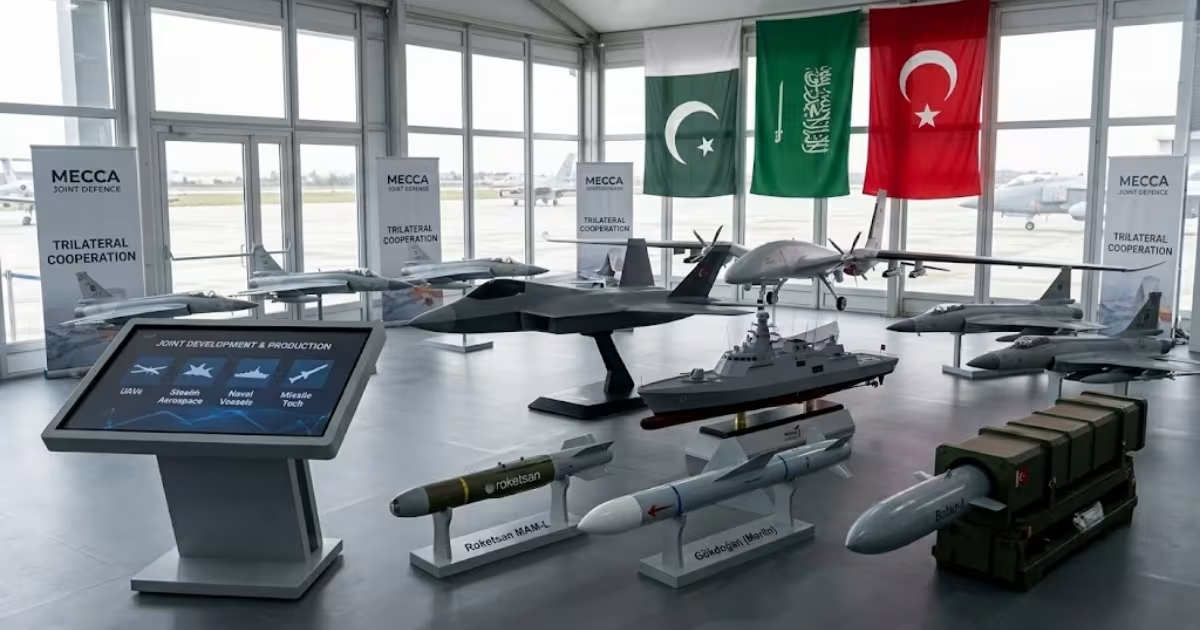
Defense Industry Collaboration: The agreement establishes formal channels for joint equipment manufacturing, technology transfers, drone co-development, and intelligence sharing.
2. Fact Check: Why the Pact Will NOT Lower Petrol Prices
Following the signing of the agreement, rumors circulated across social media platforms in Pakistan claiming that a military alliance with oil-rich Saudi Arabia would result in immediate cuts to domestic petrol prices.
This assumption is incorrect for the following reasons:
A. The Agreement Lacks Commercial Energy Clauses
The official joint statement and charter focus exclusively on mutual defense, security deterrence, and military industry coordination. There are no provisions for discounted oil imports, free petrol shipments, or commercial trade subsidies.
B. How Petrol Prices Are Calculated in Pakistan
Retail fuel prices in Pakistan are determined bi-weekly by the Oil and Gas Regulatory Authority (OGRA) and the Ministry of Finance using the following formula:
Because the Mecca Agreement does not alter global crude oil benchmarks or domestic taxation, it has no direct bearing on local pump prices.
C. Deferred Payment Facilities vs. Price Subsidies
Saudi Arabia has periodically provided Pakistan with oil import facilities on deferred payment terms. While these arrangements assist the State Bank of Pakistan by delaying foreign exchange outflows, they do not reduce the actual cost of oil. The government must pay the full market rate in the future, meaning local fuel prices remain unchanged.
3. Comparison: Military Defence Pact vs. Commercial Energy Agreement
| Structural Feature | Mecca Joint Defence Agreement | Commercial Energy / Oil Import Deal |
| Primary Focus | National security, joint deterrence, military manufacturing. | Import/export of crude oil, refined petrol, diesel, and gas. |
| Governing Bodies | Ministries of Defence & Armed Forces Command. | Ministry of Energy, OGRA, State Oil Companies (PSO, Aramco). |
| Direct Pump Price Impact | None (0% direct effect). | High (if direct price discounts or subsidies are negotiated). |
| Primary Deliverables | Joint troop exercises, drone production, naval tech, radar systems. | Oil tankers, refining capacity, long-term fuel supply guarantees. |
4. What Trade Will Occur Under the Agreement?
While consumer commodities like petrol are excluded, the agreement creates a structured framework for state-to-state trade in military hardware and defense technology:
-
Unmanned Aerial Systems (UAVs): Turkey’s advanced drone systems (such as the Bayraktar TB2 and Akıncı) will see expanded deployment, co-assembly, and optical sensor integration across Pakistani and Saudi defense facilities.
-
Naval Shipbuilding: Joint construction of combat vessels, expanding on programs like the MILGEM-class corvettes and naval submarine modernization.
-
Aerospace & Fighter Aviation: Collaboration involving Pakistan Aeronautical Complex (PAC) Kamra and Turkish Aerospace Industries on avionics, airframe components, and fighter jet systems.
-
Precision Munitions & Electronics: Transfer of guidance kits, electronic warfare systems, and radar networks developed by firms such as Roketsan and Aselsan.
5. Strategic & Long-Term Economic Impact on Pakistan
While fuel prices at the pump will not drop, the Mecca Joint Defence Agreement offers indirect economic benefits:
-
Shipping Lane Protection: Enhanced naval coordination in the Red Sea, the Gulf of Oman, and the Arabian Sea secures critical oil supply lines from piracy and regional disruption.
-
Industrial Manufacturing Growth: Joint production of military hardware brings foreign investment into Pakistan’s industrial defense sector.
-
Macroeconomic Stability: Strengthening defense ties reduces sovereign risk, improving overall foreign investor confidence in Pakistan’s broader economy.
Frequently Asked Questions (FAQs)
Will petrol prices fall in Pakistan after the Mecca Defence Agreement?
No. The agreement is purely a military defense treaty and contains no trade provisions, energy subsidies, or oil price cuts.
Why do rumors claim Pakistan will receive cheap oil from Saudi Arabia?
These rumors stem from a misunderstanding between security pacts and energy supply deals. While Saudi Arabia has previously granted deferred payment options on oil imports, those payments must still be settled at standard market rates and do not lower retail prices.
What is the main goal of the Mecca Joint Defence Agreement?
The primary goal is collective security and regional deterrence. An armed attack against Saudi Arabia, Pakistan, or Turkey is treated as an attack against all three member nations.
What factors actually determine petrol prices in Pakistan?
Petrol prices are set based on international crude oil benchmarks (MOPAG), the USD-to-PKR exchange rate, shipping margins, and government levies (Petroleum Levy and sales taxes).
Final Summary
The Mecca Joint Defence Agreement represents a milestone in strategic cooperation between Pakistan, Saudi Arabia, and Turkey. However, it operates entirely separately from commercial energy markets. Motorists and citizens should rely on official OGRA notifications for accurate fuel price updates.