Oman is the largest oil producer in the Middle East that is not a member of OPEC, pumping over 1.03 million barrels per day. Yet unlike its wealthier neighbours, the Sultanate does not enjoy bottomless hydrocarbon wealth. When global oil prices crashed in 2014–2015, Oman was hit harder than other Gulf states, forcing difficult reforms.

Current Petrol Prices in Oman (April–May 2026)

Oman sets retail fuel prices monthly through a government‑led committee (Ministry of Energy and Minerals). For April 2026, the government opted to maintain March prices unchanged, a deliberate policy choice to shield consumers from global oil price volatility during the ongoing Iran‑US conflict.

Official Omani fuel prices are publicly available on the National Subsidy System (NSS) portal, and the subsidized rate applies only to Omani citizens who have registered their vehicles in the system.

Authorized Retail Prices – April 2026

Fuel Grade

Octane Rating

Price (Baisa/L)

Price (OMR/L)

Price (USD/L)

Approx Price (PKR/L)*

M91 Petrol

91

229 Bzs

0.229

~0.60

~52 PKR

M95 Petrol

95

239 Bzs

0.239

~0.62

~54 PKR

Diesel

258 Bzs

0.258

~0.67

~59 PKR

M98 Super Premium

98

~270 Bzs

0.270

~0.70

~61 PKR

Price Evolution (October 2025 – May 2026)

Month

M95 (Baisa/L)

Diesel (Baisa/L)

Key Event

October 2025

216

208

Pre‑war stability

November 2025

218

208

December 2025

218

208

January 2026

224

228

February 2026

227

224

March 2026

239

258

Increase after Strait of Hormuz tensions

April 2026

239

258

Prices frozen (no further increase)

May 2026

239

258

Further adjustment pending

Source: NSS Oman, Global Petrol Prices.

Price Stability Note: From 2016 to 2025, the average gasoline price in Oman was OMR 0.22 per litre, ranging from a minimum of OMR 0.16 in May 2016 to a maximum of OMR 0.24 in July 2021. Despite the recent rise, prices remain within historical norms.

Historical Price Trends (2007–2026)

Since 2007, gasoline prices in Oman have averaged approximately USD 0.53 per litre. Historical extremes include.

 
PeriodPrice (USD/L)Event
December 20080.31 (record low)Global financial crisis
February 20220.62 (record high)Post‑COVID demand surge / Russia‑Ukraine war
May 20160.41 (post‑deregulation low)Initial deregulation period [8†L7-L8]

Long‑Term Average (2007–March 2026): OMR 0.22 per litre (approx USD 0.57)

Key observation: After the 2016 deregulation, prices became more responsive to global oil price swings, yet Omani consumers still pay well below European or Asian levels.

Oman’s Oil Sector – Production, Reserves & Economy

MetricValueGlobal Rank
Proven oil reserves4.8–5.4 billion barrels#22 globally
Daily production (2024)1,001,970 barrels#19 globally
Oil as % of GDP (2017)39%
Target oil % of GDP (2040)8.4%

In March 2026, Oman announced new oil discoveries expected to raise production by 50,000 to 100,000 barrels per day over the next two to three years. Further discoveries in April 2026 at the Hasirah Ridge are slated to bring first oil onstream by Q4 2026, with development continuing through 2028 .

Despite not being an OPEC member, Oman voluntarily coordinates with OPEC+ on production targets. In May 2026, Oman is projected to produce approximately 220,000–230,000 barrels of oil equivalent per day (boepd) under the latest OPEC+ adjustment.

petrol price in Oman adjustment process

Who Decides? – The Monthly Price Setting Mechanism

Since January 15, 2016, Oman has deregulated its fuel market, moving away from heavy government subsidies. A dedicated committee, comprising officials from the Ministry of Oil and Gas, monitors global oil price movements and adjusts domestic retail prices accordingly.

The committee follows a dynamic pricing model that tracks international petroleum benchmarks, allowing prices to be modified periodically to keep them aligned with the broader market . Typically, there is a two‑to‑three‑week lag between crude oil price changes and retail fuel adjustments, even in liberalised markets.

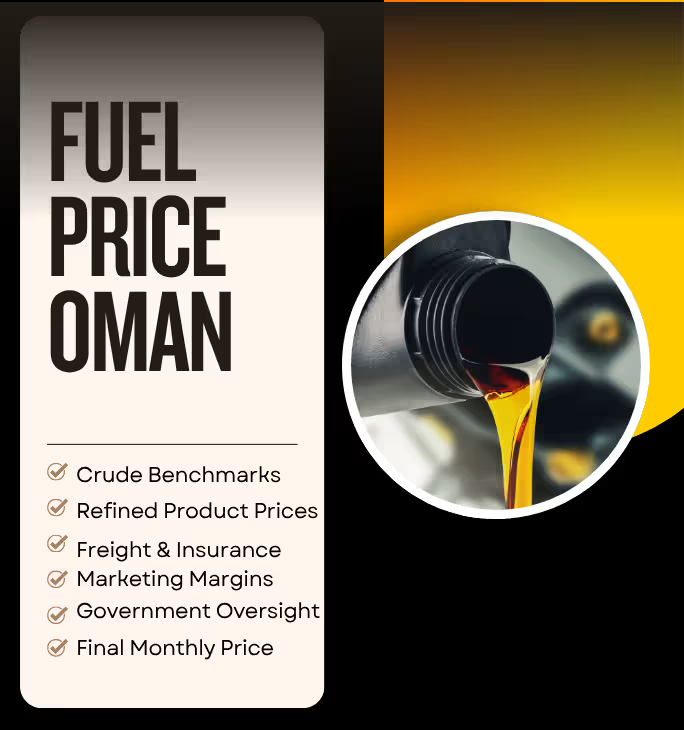
While the exact algorithm is not publicly disclosed, the mechanism factors in:

  • International crude oil benchmarks (Brent, Dubai Crude)

  • Refined product market prices (gasoline, diesel, kerosene)

  • Freight, insurance, and handling costs

  • Marketing company margins (Shell Oman, OOMCO, Al Maha Petroleum)

The government retains final approval authority, ensuring that price increases are modulated to prevent sudden economic shocks.

The Two ‑Tier Subsidy System – How the National Subsidy Scheme Works

Oman heavily subsidises gasoline prices to keep them affordable for its citizens and residents, paying the difference between the actual import/refining cost and the retail price.

MetricValue
Petroleum sector subsidies (2024)RO 232 million (~$603 million)
Total subsidy spend (10th Plan, 2016‑2020)$18.9 billion
Subsidy on transport fuelsRO 1.464 billion (20% of total)

National Subsidy System (NSS) Card

In a critical shift, the government replaced blanket fuel subsidies with a targeted social protection scheme. Under the NSS, fuel subsidies are now limited to:

  •  

Omani citizens only

Expats pay the unsubsidised market rate

Registered vehicles

Only cars listed in the National Subsidy System qualify

Specific segments of Omani society to mitigate liberalisation effects

  1. Eligible citizens receive a subsidy card from their preferred fuel station after registering on the NSS portal.
  2. The government allocated RO 614 million for the social protection system in the 2026 budget to support this transition.
  3. Finance Minister Sultan bin Salem Al Habsi has confirmed that while existing support mechanisms will continue, there are no current plans to further lift or change electricity and fuel subsidies.

Why Fuel Subsidy Reform Happened in 2016

The 2014–2015 oil price crash was a fiscal earthquake in Oman. Oil revenues dropped more than 60% as crude plunged from 100 per barrel to below 100 per barrel to be low 40. 

Key Reforms Implemented

  1. January 2016: Full fuel price deregulation, with prices increasing up to 33%

  2. Corporate tax raised from 12% to 15%

  3. Spending cuts across civil ministries and defense

  4. Fuel subsidies slashed from RO 1,134.6 million (2014) to RO 479.3 million (2015) — a 57.8% decline

By 2024, subsidy reforms had delivered estimated savings of RO 479 million from fuel subsidies and RO 386 million from electricity subsidies

image of Oman Vision 2040

Oman Vision 2040 – Diversifying Away from Oil

Launched in 2021, Oman Vision 2040 is the Sultanate’s ambitious economic diversification plan. Key targets include:

  1. Reduce oil’s share of GDP from 39% (2017) → 16% (2030) → 8.4% (2040) 
  2. Introduce sustainable finance frameworks to attract ESG investment 
  3. Implement fiscal reforms, including VAT introduction (now 5%) 

IMF Endorsement

In November 2024, the IMF completed its Article IV Mission to Oman, noting that reform implementation under Oman Vision 2040 is proceeding decisively, with progress made on strengthening social safety nets 

Oman vs Pakistan – A Direct Price Comparison

For Pakistani readers, the cost difference between the two nations is striking. Using current exchange rates (1 OMR ≈ PKR 724.98)

image of pump and heading of Petrol price in Oman vs Pakistan
Fuel TypesOman Price (OMR/Ltr)Oman (Approx PKR/Ltr)Pakistan (Approx PKR/Ltr)
Super (95/98)~0.250 – 0.280 OMR~PKR 180 – 200~PKR 399.86
Special (91)~0.240 – 0.260 OMR~PKR 175 – 190Not Widely Used
Diesel~0.300 – 0.350 OMR~PKR 215 – 250~PKR 399.58

Exchange Rate Used: 1 OMR ≈ 725 PKR (approximate as of May 1, 2026).

Key reasons for this massive disparity:

FactorOmanPakistan
Oil production capacityOver 1 million bpd (exporter)~81,000 bpd (importer)
Import dependencyLow (self‑sufficient)83% imported
Fuel taxationMinimal taxes, targeted subsidiesHeavy petroleum levy (~Rs80.61/L)
Exchange rateOMR strong, stable (pegged)PKR volatile, depreciating

Global Factors Impacting Future Prices

The ongoing Iran‑US conflict has forced a reduction in Oman’s oil exports, as the Strait of Hormuz — through which Gulf oil passes — has been partially closed since February 2026. In April 2026, Oman made a deliberate policy choice to hold fuel prices steady despite rising international oil costs, absorbing the difference through government subsidies.

Oman’s inflation rose 2% in February 2026 year‑on‑year, accelerating to 3.6% in March. Prices for housing, water, electricity, gas, and other fuels are being monitored closely, although fuel price caps have helped contain broader inflationary pressures.

Conclusion

Oman represents a fascinating middle ground in Gulf energy policy. It lacks the immense hydrocarbon wealth of Saudi Arabia or the UAE, yet it has managed to balance fiscal sustainability with consumer protection. The January 2016 partial deregulation was a pivotal moment one that reduced subsidy burdens without causing social unrest.

For Pakistani readers, the contrast is stark. While Pakistan’s fuel consumers pay among the highest prices in the region due to heavy taxation and import dependency, Oman’s integrated oil sector and targeted social protection system keep pump prices low for citizens and residents alike.

According to my analysis,  For the foreseeable future, Omani drivers will continue to enjoy some of the cheapest petrol in the Gulf region but the system is not static. As Vision 2040 progresses, further subsidy reforms are likely, gradually aligning domestic prices more closely with international market realities.

Frequency Asked Question

As of 20 April 2026, the retail price of Octane-95 petrol stood at OMR 0.24 per litre, equivalent to USD 0.62. For comparison, the average price of petrol worldwide at that time was USD 1.42 per litre.

It varies widely per country (Global Petrol Prices, 2026):

  • World average: $1.41

  • USA: $1.13

  • UK: $1.93

  • Germany: $2.40

  • India: $1.08

  • Pakistan: $1.51

In Europe the Netherlands recorded the highest price at €2.46 per litre, while outside Europe Hong Kong was the most expensive at €2.90 (approx. $2.98) per litre

As of 20 April 2026, the global average petrol price was $1.42 per litre, but could be much higher in your country

These are generally oil-rich nations with heavy subsidies (Visual Capitalist, 2026):

  • Libya: $0.09 per gallon

  • Iran: $0.11 per gallon

  • Venezuela: $0.13 per gallon

  • Angola: $1.24 per gallon

  • Kuwait: $1.28 per gallon

Brent is the world’s most important benchmark for crude oil prices, used to price about two-thirds of all internationally traded crude

In terms of proven reserves, Venezuela holds the largest at 303 billion barrels

Since February 2026, Asian buyers, particularly Japanese refiners, have aggressively outbid others for US crude to replace disrupted Middle Eastern supplies

Futures are derivative contracts; the four main types are CommodityCurrencyInterest Rate, and Stock Index Futures

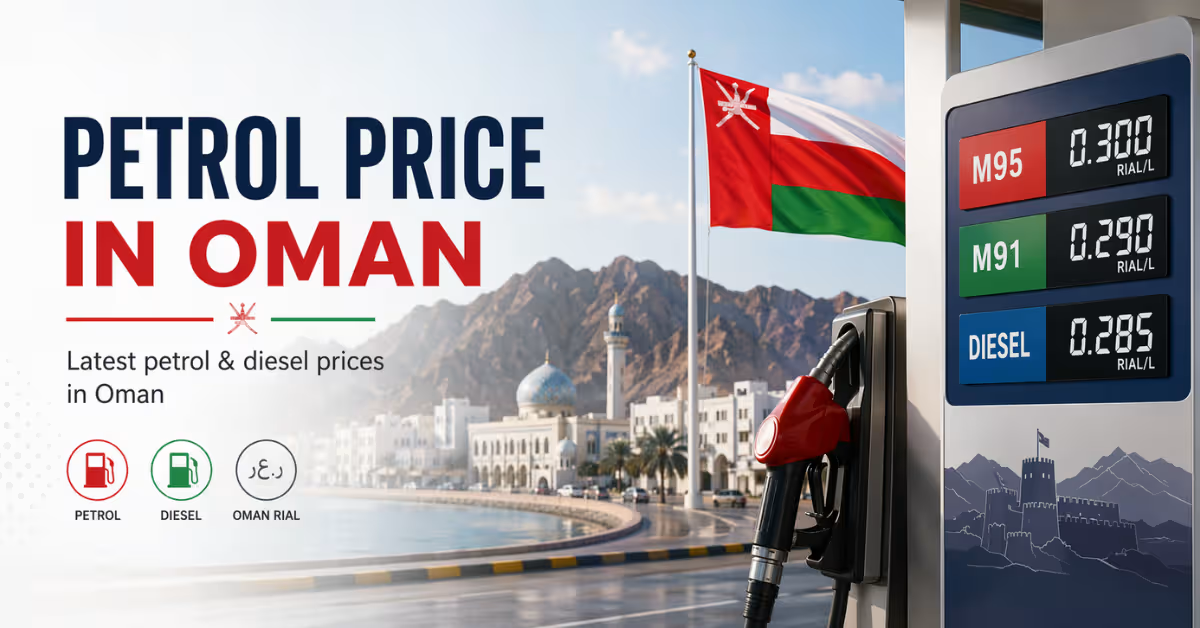
As of May 2026, the current petrol prices in Oman are 229 baisa per litre (M91) and 239 baisa per litre (M95). Diesel is priced at 258 baisa per litre. These rates have been unchanged since April 2026.

Since January 2016, Oman has moved to a monthly price adjustment system to align domestic fuel prices with international oil markets. A government committee reviews global crude prices and refined product benchmarks before setting the next month’s rates.

Yes. Oman still provides subsidies on fuel, but they are now targeted through the National Subsidy System (NSS). Omani citizens with registered vehicles can apply for a subsidy card that entitles them to lower pump prices.

Oman’s petrol is approximately 6.8 times cheaper than in Pakistan. A 50‑litre refuel in Oman costs about 12 OMR (≈₨2,670 PKR), while the same amount in Pakistan costs roughly ₨18,300 PKR. The huge gap stems from Oman’s domestic oil production (over 1 million bpd) versus Pakistan’s 83% import dependency.